
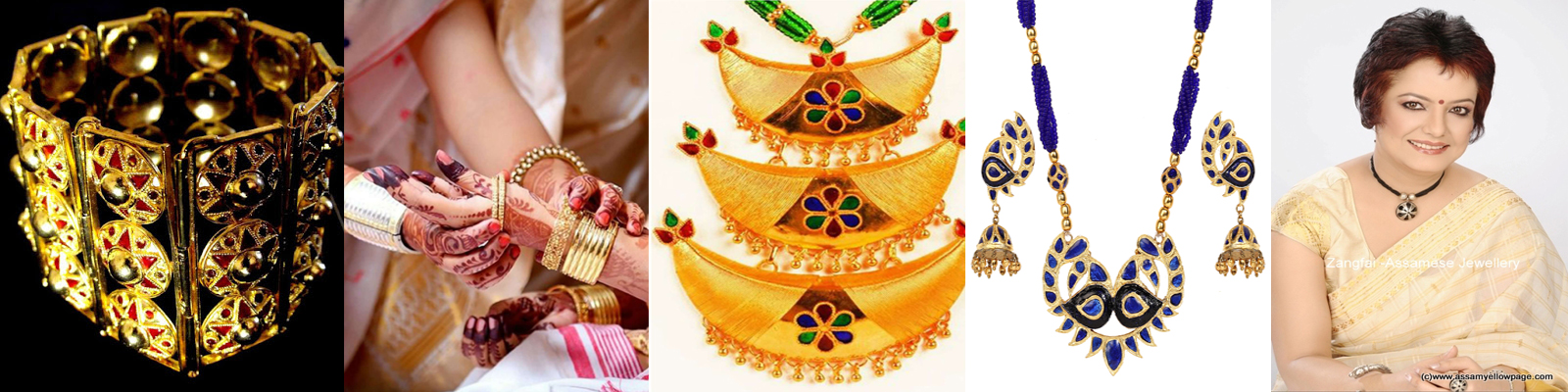
HERITAGE OF ASSAMESE JEWELLERY
Gold washing and manufacture of jewellery were two important ancient industries in Assam & gold dust was abundantly found in the sands of different rivers of the state. References to gold in Assam in the early periods are found in the writings of the classical writers and the earliest reference is found in the ARTHASASTRA. During the rule of the Ahom Kings, gold washing was done on an elaborate scale and the state derived considerable income from the yearly tax levied on gold washing.
An idea of the variety and excellence of the ancient Jeweller’s skill may be derived from a perusal of the list of presents to King Harsavardhana from King Bhaskarvarmana of Kamrup as described by the court poet Bana. Bana mentioned the exquisite ornamented “ABHOGA” umbrella with Jewelled ribs: ornaments which crimsoned the heavenly spaces with the light of the finest gems: shining crest Jewels : pearl necklaces which seemed the source of the milk ocean’s whiteness: quantities of pearls, shells, sapphire and other drinking vessels by skillful artist, cages of coral and ring of ivory, encrusted with rows of huge pearls from the brows of elephants.
A large quantity of gold was used in making ornaments. F.C. Hanniker in his monograph on gold and silver wares of Assam writers: “ Assam Jewellery is by no means without merit. It incurs the stock reproach of the being unfinished, it is no doubt crude and precious stones used are not very precious or very well cut. But it is quaint and characteristic. The gold used of a high degree of purity. The Assamese goldsmiths’ customers would not be satisfied with 14 carat or even 18 carat gold and many of the bracelets, necklaces etc. are distinctly pleasing even to the critical eye and would attract notice in the midst of quite a good collection of the Indian wares”. According to F.C. Hanuikers, there were a considerable number of goldsmiths and dealers in the districts of Kamrup, Goalpara and Sibsagar. In the district of Kamrup, Barpeta was the well-known Centre of the trade. In the whole province, Jorhat was alone proud of enameling works, known as “Mina Kara” in Assamese.
Enameling on gold was done mainly at Jorhat. The artificers were SUNARS and possessed a fair amount of skill. There were many SUNARS in Jorhat who worked on gold only. The Enamel was o three kinds, a dark blue, dark green and white but red and yellow were sometimes used. Another important place where gold and silver work was carried on extensively was Barpeta. It is learnt that during the reign of Ahom Kings, the work done by the local goldsmith were not very fine. So King Rudra Singha imported goldsmiths from Benaras for manufacture of better quality of gold and silver ornaments.
The ornaments worn by men and women on different parts of their bodies were of different designs. The Kalika Purana names forty different types which were made of the both gold and silver. The different metals and other materials used for the making of ornaments were gold, silver, copper, brass, bronze, amber, rhinoceros’ horns,ivory etc. Different kinds of valuable jewels and stones were also used as ornaments. The ornaments of gold, silver, amber, ivory were precious and beautiful to look at by setting precious stones and jewels on them.
Both Assamese men and women used to were ornaments. The male put on ornaments on their neck, hands, fingers and ears. The Kings and officials of the highest cadre used to put on ornaments on the toes of the feet as well as on the ankle-joints. The male put on the bracelet made of either gold or silver on the wrists of their hands known as Gam-Kharu. Most of the neck ornaments (Hara) were made of Beads. The necklace with bigger beads called MATAMANI a larger bead of the shape of the Rudraka, or a drum shaped ornaments called Madal or Biri were put on by males. On their ears, they put on different varieties of the ear-rings such as LOKAPARA and LONGKERU. On the arms, ornaments called BAJU or KANKAN were put on. They put on rings made of gold or silver and of various shapes and designs. On the ankle joints of the feet, an ornament called NUPUR was used. It has small balls inside which produce a tinkling sound. The rings put on the toes of the feet are called UJANTI. The Nobles and the high officials threshed on the turbans of their heads an ornament called SIROPES or feathers of birds, in order to make it more beautiful.
The ornaments put on by the women were more or less of similar kind. Women also put on ornaments on the nose and on the head. The ornaments put on the nose by women are called NAKPHUL.
Some ornaments used in the medieval period are still in use. The names applied to the ornaments are made of various shapes and design. The names applied to the ornaments are mostly descriptive and themselves indicates the shape and decorative work to the ornaments in most cases. Some names are given according to the design of the ornaments and some again according metal of the ornament with which it is made of. For example JONBIRI means an ornament made in the shape of the crescent moon.
ORNAMENTS USED AS NECKLACE:
Jonbiri Dhol Biri, Silikha madali. Gejera. Bana, Dokmala, Kathal Kuhia madali, Dugdugi, Sonar
har, Dhari, Biri were put on both by males and women except Japhar madali and Gejera which were worn by women only. The
ornaments such as, Galakantha, Chandra Har, Rupadhar, Galpata, Pechhandar, Kautha Sobha, Gajamati har were put on as
necklace by women only.
EAR-ORNAMENTS:
Among the different ear-ornaments mention can be made of Lokapara, Lang Keru, Thuria, Dighal keru, Bakharna
Keru, UKA keru, Titakaria keru, Jangphai keru, Kanthasa, Karnaphul.
RINGS:
Rings are called Angathi in Assamese. The rings of various designs were Jethineguri Angathi, Patia Angathi,
Babari phulia Angathi etc.
BRACELETS:
Gam Kharus were used by the males only. There were other bracelets such as Epatiabala, Dopatia bala, Muthi,
Satjuri Muthi, Sonkhatowa Kharu, Eptia Magar Khatowa bala, Uka Kharu, Chheo etc. On the arms of their hands both men and
women were ornaments called Baju, Kankan, Tar, Balay etc. a forehead ornaments (tilaka or lalatika) which was also known
as citipoti was generally worn by women just below the parting of hair on the top of the forehead.
ROYAL ORNAMENTS OF THE AHOM KINGS:
The Ahom Kings had many valuable ornaments which were kept in the royal store house.
The Ornaments used by the Kings were the nine jewels set on gold plate, the pearl, the diamond, different kinds of
necklaces knows as Pachari, Satsari, Navasari, Chandhrahar, and Gazera etc. other ornaments used by the Kings were
different kinds of ear rings, such as Karnabhusan, Karnabala, Makara Kundala, Hangsakundal, Kundal and Lokapara: different
kinds of armlets called Baju ;different kinds of bracelets; head dresses such as Siropes, Kalki, Diadems called Kiriti Mukut
etc.